Feel more confident by filling the gap using traditional dental bridges.
We never really notice just how important our teeth are until we lose them. If you have lost a tooth, you are probably struggling daily with biting and chewing. You may even feel conscious about talking, smiling, and laughing around other people.
Missing a tooth or teeth can really affect not only functionality but appearance as well. For this reason, many people choose to get it fixed as quickly as possible. This is where dental bridges come in.
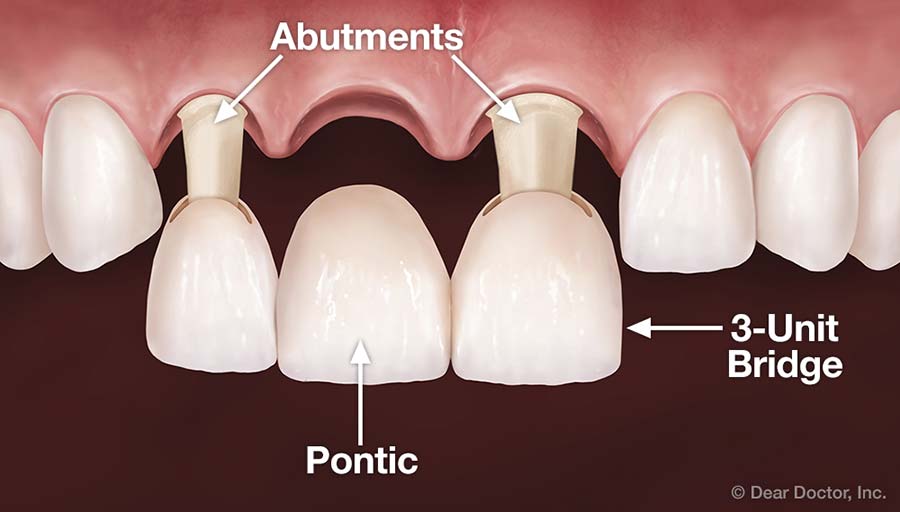
A dental bridge is basically a false tooth known as pontic that is custom-made for you to replace your missing tooth. It is literally a “bridge” that connects the adjoining teeth. It is held in place by the two teeth on either side of the missing tooth/teeth. These teeth are known as abutment teeth.
WHAT ARE THE DIFFERENT TYPES OF DENTAL BRIDGES?
There are different types of dental bridges. I will help you choose the best option depending on your needs and goals. Here are the four most common types of dental bridges I have learned.
Traditional dental bridge
These are the most common types of bridges. Traditional dental bridges consist of a false tooth/teeth or pontic that is held in place by crowns that are cemented on the abutment teeth located on both sides. This is possible when you have natural teeth on both sides of the dental gap.
Maryland dental bridge
A Maryland dental bridge is very similar to a traditional dental bridge. It also consists of a false tooth that is held in place by natural teeth or abutment teeth on both sides of the missing tooth/teeth. However, the difference is that with the Maryland dental bridge, the pontic has a framework of metal or porcelain that is bonded to the two abutment teeth.
Cantilever dental bridge
A cantilever dental bridge is a replacement tooth that is held in place by only one abutment tooth on one side, rather than two on both sides. This is a common option if you have a natural tooth only on one side of your missing tooth or teeth.
Implant-supported dental bridge
Implant-supported dental bridges use dental implants surgically placed into the jaw to hold the replacement tooth in place. One dental implant will be used for each missing tooth, and the implant secures the bridge so that it completely replaces the missing tooth. This is the strongest and most stable type of dental bridge as the foundational structure for the bridge is surgically placed into the jaw.
Why Do You Need A bridge?
Dental Bridge
Unlike a chipped tooth a missing a tooth or teeth can be very debilitating. If a tooth is broken, we can use a metal free crown.
But missing tooth or teeth impair the functionality of your teeth in chewing and biting, making eating difficult as mentioned above. This can lead to further pain and damage. The teeth around the gap may even grow and tilt towards the empty space, thus causing serious misalignment. Your teeth are designed to work together as a whole, and when even just one is missing, you will see that it becomes a problem. The pressure provided by the ex-teeth are altered. Therefore, the arrangement changes.
Apart from this, missing a tooth or teeth affects your appearance and, consequently, your confidence. Smiling, laughing and talking – things that you used to do without thinking now make you feel conscious and uncomfortable around other people.
A missing tooth or teeth also affect the shape of your jawbone. When one or more teeth are missing, the bone can shrink, which can affect the way your lips and cheeks are supported. If this goes untreated for a long time, it can make your face appear older.
CROWNS SO NATURAL LOOKING YOU’LL THINK THEY ARE REAL TEETH.
A chipped tooth can ruin your appearance and also increase the risk of long-term dental damage. Crowns are the best way to protect your teeth and ensure they’re safe from harm. Metal-free crowns are teeth restorations that are entirely made of ceramic, providing high aesthetic value. The most favourable part about metal-free crowns is that they look very similar to natural teeth, making them the more favoured option today.
WHY ARE METAL-FREE CROWNS RECOMMENDED?
The metal-free crowns available in the dental world today are highly praised for their biocompatible nature. For this reason, several patients prefer to opt for this procedure while also experiencing added benefits. Metal-free crowns are made of high-quality materials and are also very durable. For a sensitive area like the teeth, it is important to go for the more comfortable option, which will not cause you any discomfort in your day-to-day life; therefore metal-free crowns are the best option.
Metal-free crowns are recommended for those who have a tooth that is damaged but has remained attached in the mouth. The crown will be placed in this area to mitigate the ill-effects of decaying teeth.
The mechanical properties of metal-free crowns align with the more traditional metal-ceramic crowns, but they also have other advantages.
There have been several technological advancements in porcelain manufacturing and adhesion, which means that dentists can save more teeth with the help of many different metal-free crown options. In traditional metal-ceramic crowns, the metal alloy portion of the fitting is fused with dental ceramic in order to give it a more appealing appearance.
HOW DOES THE PROCEDURE WORK?
The procedure requires the dental substance to be removed, which means that the teeth will have to be filed down in order to start with the procedure. With metal-ceramic crowns, the dentist will have to file down 1.5-2.0mm of dental substance, making it a more arduous procedure.
On the other hand, the option of metal-free crowns will require the dental experts only to remove 0.3-1.0mm of dental substance, making it a more comfortable procedure for you.
After this, the dentists will take an impression of your bite and then go on to prepare a mould for the crown. The porcelain used for the procedure will have to be colour-matched with your natural teeth in order to give it a more natural appearance. It is common for you to be fitted with a temporary restoration until the permanent fitting for your teeth is ready to be fitted.
WHAT ARE THE CROWNS MADE OF?
Metal-free crowns are most often made of zirconium or lithium-disilicate ceramic. These elements allow the material to have a few similarities with glass, especially making them light and transparent. These properties make the metal-free crowns as resistant as natural teeth.
After the treatment, the dental experts will guide you with the aftercare required for the maintenance of your crowns. You may experience some sensitivity to hot and cold substances, which will subside soon.
WHAT ARE THE PRIMARY ADVANTAGES OF METAL-FREE CROWNS?
The most natural-looking restorations – Metal-free crowns are made with all-porcelain, which will provide you with the most natural-looking solution for damaged teeth. With metal or metal-ceramic fittings, you may have noticed that the black lines of the fitting are visible, especially around the gum line. This line will be a constant reminder of the crowns. On the other hand, with metal-free crowns, the light passes through the porcelain material in a fashion similar to that of the natural tooth enamel, making your smile bright and radiant.
Easy shade matching – The option of metal-free, porcelain crowns makes it much easier for our dental experts to shade match your teeth with the crown. There are several customized porcelain shades available that match the natural teeth, which can be shined with natural light lamps, ensuring that it offers proper reflection before they can be placed.
High Durability – The metal-free crowns are made with porcelain, which is very durable, making it the right choice for our teeth. The option of porcelain makes it even better for someone who is suffering from tooth decay. The material used for the procedure is long-lasting and can protect you from bacteria and other germs that are responsible for tooth decay.
Say bye to allergic reactions – One of the biggest advantages that come with metal-free crown restorations is that it does not cause any allergies. The traditional metal crowns can cause the gums and sockets of the teeth to become inflamed and irritated, causing you much discomfort. Metal-free crowns are made to avoid causing any reactions in the surrounding tissue, which also enables the gingiva to shape around the crowns, just like natural teeth.