Gametogenesis

Gametogenesis is the production of gametes from haploid precursor cells. In animals and higher plants, two morphologically distinct types of gametes are produced (male and female) via distinct differentiation programs. Animals produce a tissue that is dedicated to forming gametes, called the germ line.

Now we are going to learn about the,

  1. The Germ Line
  2. Sexual Differentiation
  3. Spermatogenesis
  4. Oogenesis

The Germ Line

The primordial germ cells(PGCs) are the ancestors of the germ line. They are diploid.

In the second week of the human embryo these can be already found in the primary ectoderm (epiblast).

In the third week, the PGCs wander from the primary ectoderm to yolk sac wall. And they collect near the allantois. Now they are extraembryonal.

Between the fourth and the sixth week PGCs wander back into the embryo. They move along the yolk sac wall to the vitelline and into the wall of the rectum. After crossing the dorsal mesentery they colonize the gonadal ridge.

For both sexes the gonads arise in the gonadal ridges. They are generated in the 5th week. At this point, the gonadal ridge represents the primitive gonadal primordium.

Sexual Differentiation

The gender of an embryo is determined at the moment of fertilization and depends on whether the spermatozoon carries an X or a Y chromosome.

In XX embryos the germinal cords do not grow as far as the medulla and the cortical cords envelop the oogonia.

In XY embryos, on the other hand, the medullary cords become the testicular cords that also grow into the depths and establish contact with the mesonephros.

Spermatogenesis

Spermatogenesis is initiated in the male testis with the beginning of puberty.

This comprises the entire development of the spermatogonia (former primordial germ cells) up to sperm cells.

The gonadal cords develop a lumen. They then transform themselves into spermatic canals.

They are termed convoluted seminiferous tubules (Tubuli seminiferi contorti).

They are coated by a germinal epithelium that exhibits two differing cell populations: some are sustentacular cells (= Sertoli’s cells) and the great majority are the germ cells in various stages of division and differentiation.

The maturation of the germ cells begins with the spermatogonia at the periphery of the seminal canal and advances towards the lumen over spermatocytes I (primary spermatocytes), spermatocytes II (secondary spermatocytes), spermatids and finally to mature sperm cells.

The epithelium consists of Sertoli’s sustentacular cells and the spermatogenic cells.

Spermatogenesis is thus accomplished in close contact with the Sertoli’s cells, which not only have supportive and nourishing functions, but also secrete hormones and phagocytize cell fragments.

Along the course of spermatogenesis the germ cells move towards the lumen as they mature. The following developmental stages are thereby passed through:

  1. A-spermatogonium
  2. B-spermatogonium
  3. Primary spermatocyte (= spermatocyte order I)
  4. Secondary spermatocyte (= spermatocyte order II)
  5. Spermatid
  6. Sperm cell (= spermatozoon)


The spermatogenesis can be subdivided into two successive sections:

The first comprises the cells from the spermatogonium up to and including the secondary spermatocyte and is termed spermatocytogenesis.

The second one comprises the differentiation/maturation of the sperm cell, starting with the spermatid phase and is termed spermiogenesis (or spermiohistogenesis).

The approximate 64 day cycle of the spermatogenesis can be subdivided into four phases that last differing lengths of time:

Mitosis of the spermatogonia16 DaysUp to the primary spermatocytes
Meiosis I24 DaysFor the division of the primary spermatocytes to form secondary spermatocytes
Meiosis IIFew HoursFor engendering the spermatids
Spermiogenesis24 DaysUp to the completed sperm cells
Total64 Days

Among the spermatogonia that form the basal layer of the germinal epithelium, several types can be distinguished: 1. Type A cells that undergo homonymous division. 2. Type A cells undergo heteronymous division.

After a further mitotic division type B spermatogonia divide into primary spermatocytes (I) which enter first meiosis.

They then go immediately into the S phase, double their internal DNA.

Following the S phase, these cells attain the complex stage of the prophase of the meiosis and become thereby noticeably visible with a light microscope.

This prophase, which lasts 24 days, can be divided into five sections:

Leptotene
Zygotene
Pachytene
Diplotene
Diakinesis

After the long prophase follow the metaphase, anaphase and telophase that take much less time. One primary spermatocyte yields two secondary spermatocytes.

The secondary spermatocytes go directly into the second meiosis, out of which the spermatids emerge. In the secondary spermatocytes neither DNA reduplication nor a recombination of the genetic material occurs.

Through the division of the chromatids of a secondary spermatocyte, two haploid spermatids arise that contain only half the original DNA content. In a process called spermiogenesis they are transformed into sperm cells with the active assistance of the Sertoli’s cells.

In examining a cross-section of a convoluted seminiferous tubule sometimes it is noticeable that cells appear in groups having the same maturation stages. Because, daughter cells generated by each meiotic step remain bound together by thin cytoplasmic bridges.

Thus with each meiotic step the following generation is twice as large, until the cells have formed a relatively complex network.

The result is that cells of the same development stages are seen there in groups.

Thus, it is highly improbable that all of the development stages will be seen in a single section at the same time. However, not all the spermatogenesis stages are found in a cross-section.

The differentiation of the spermatids into sperm cells is called spermiogenesis. It corresponds to the final part of spermatogenesis and comprises the following individual processes that partially proceed at the same time:

  • Nuclear condensation: thickening and reduction of the nuclear size, condensation of the nuclear contents into the smallest space.
  • Acrosome formation: Forming a cap (acrosome) containing enzymes that play an important role in the penetration through the pellucid zone of the oocyte.
  • Flagellum formation: generation of the sperm cell tail. Four parts of the finished flagellum can be distinguished: The neck, the mid piece, the principle piece, and the tail.
  • Cytoplasm reduction: elimination of all unnecessary cytoplasm

Leydig’s interstitial cells are endocrine cells that mainly produce testosterone. An initial active stage of these cells occurs during the embryonic development of the testis.

Oogenesis

Following the immigration of the primordial germ cells into the gonadal ridge, they proliferate. They form germinal cords. Now a cortical zone and a medulla can be distinguished. Because, in females the germinal cords never penetrate into the medullary zone.

In the genital primordium the following processes then take place:

  1. A wave of proliferation begins that lasts from the 15th week to the 7th month: primary germ cells arise in the cortical zone.
  2. With the onset of the meiosis (earliest onset in the prophase in the 12th week) the designation of the germ cells changes. They are now called primary oocytes. The primary oocytes become arrested in the diplotene stage of prophase I. Shortly before birth, all the foetal oocytes in the female ovary have attained this stage. The meiotic resting phase that then begins is called the dictyotene and it lasts till puberty. Only a few oocytes (secondary oocytes plus one polar body), though, reach the second meiosis and the subsequent ovulation. The remaining oocytes that mature each month become atretic.
  3. While the oogonia transform into primary oocytes, they become restructured so that at the end of prophase I (the time of the dictyotene) each one gets enveloped by a single layer of flat, follicular epithelial cells. (oocyte + follicular epithelium = primordial follicle).

The developmental sequence of the female germ cells is as follows:
Primordial germ cell – oogonium – primary oocyte – primary oocyte in the dictyotene
Birth
The continuation of the development / maturation of the oocyte begins again only a few days before ovulation (see fertilization module).

The developmental sequence of a follicle goes through various follicle stages:
Primordial follicle – primary follicle – secondary follicle – tertiary follicle (graafian follicle)
Since a follicle can die at any moment in its development (= atresia), not all reach the tertiary follicle stage.

An ovary is subdivided into cortical (ovarian cortex) and medullary compartments (ovarian medulla).
Both blood and lymph vessels are found in the loose connective tissue of the ovarian medulla.
In the cortical compartment the oocytes are present within the various follicle stages.

The sex hormones influence the primordial follicles to grow and a restructuring to take place. From the primordial follicles the primary follicles, secondary follicles, and tertiary follicles develop in turn. Only a small percentage of the primordial follicles reach the tertiary follicle stage – the great majority meet their end beforehand in the various maturation stages. Large follicles leave scars behind in the cortical compartment and the small ones disappear without a trace.
The tertiary follicles get to be the largest and, shortly before ovulation, can attain a diameter up to 2.5 mm through a special spurt of growth. They are then termed graafian follicles.

During the foetal period, the count of germ cells in the female organism is subject to large variations. These arise due to the fact that the phases of proliferation and decomposition of oocytes take place partially stepwise and partially in parallel.

The normal, common fate of a follicle or female germ cell is known as atresia – ovulation represents an exceptional destiny.

The number of germ cells decreases from the 20th week in order that they are all gone by about 50 years of age. Even though the decrease actually proceeds continuously, three moments in the life of a woman are apparent in which this takes place more rapidly. The largest decrease occurs in the 20th week after the maximum number of 7 million germ cells (per ovary) is reached, thus still in the foetal period. Immediately following birth a further, short period of accelerated decline happens. The third, temporally longest period, of increased decline takes place during puberty.

One terms the decline or the regression of follicles of each stage at every time in the life of a woman follicular atresia. These follicles do not ovulate and the name is derived from that fact. Follicle atresia occurs more intensely, though, at certain moments (foetal period, early postnatal, begin of the menarche).

Of the roughly 500’000 follicles that are present in the two ovaries at the beginning of sexual maturity, only around 480 reach the graafian follicle stage and are thus able to release oocytes (ovulation). Ovulation represents an exceptional fate of a follicle.

Cyclic changes in the hormonal cycle are responsible for the periodicity of the ovulation. In a woman, the rhythmic hormonal influence leads to the following cyclic events:

  1. the ovarian cycle (follicle maturation) that peaks in the ovulation and the subsequent luteinization of the granulose cells
  2. cyclic alterations of the endometrium that prepare the uterine mucosa so fertilized oocytes can “nest” there. In the absence of implantation, the mucosa will be eliminated (menstrual bleeding).

In the centre of this hormonal control is the hypothalamamics-hypophysial (pituitary gland) system with the two hypophysial gonadotropins FSH and LH. The pulsating liberation of GnRH by the hypothalamus is the fundamental precondition for a normal control of the cyclic ovarian function.

This cyclic activity releases FSH and LH, both of which stimulate the maturation of the follicles in the ovary and trigger ovulation. During the ovarian cycle, estrogen is produced by the theca interna and follicular cells (in the so-called follicle phase) and progesterone by the corpus luteum (so-called luteal phase).

As a rule, the ovarian cycle lasts 28 days. It is subdivided into two phases:

  • Follicular phase: recruitment of a so-called follicle cohort and, within this, the selection of the mature follicle. This phase ends with ovulation. Estradiol is the steering hormone. Normally, it lasts 14 days, but this can vary considerably!
  • Luteal phase: progesteron production by the “yellow body” (= corpus luteum) and lasts 14 days (relatively constant)

During the follicular phase, a cohort of follicles is recruited from which a dominant follicle is selected that will develop into a De Graaf follicle. The cohort of tertiary follicles that will deliver the de Graaf follicle that will ovulate on day 14 of a cycle has started its maturation about 6 months earlier

  • The development of the primary follicle into a secondary follicle takes more than 120 days.
  • The development of the secondary follicle into a tertiary (or cavitary or antral) follicle takes about 71 days.
  • The terminal development of the tertiary follicle into a Graaf’s follicle lasts 2 weeks and starts at D0 of the menstrual cycle and ends at D14 with ovulation. This last phase is dependent on gonadotropins (LH and FSH) and starts as soon as the corpus luteum of the preceding cycle has regressed.

Introduction To Embryology

Embryology is the branch of biology that studies the prenatal development of gametes, fertilization, and development of embryos and foetuses. Additionally, embryology encompasses the study of congenital disorders that occur before birth, known as teratology.

Embryology can be mainly studied under two main divisions. They are EMBRYOGENESIS and ORGANOGENESIS.

Embryogenesis is the process of initiation and development of an embryo from a zygote (zygotic embryogenesis) or a somatic cell (somatic embryogenesis). Embryo development occurs through an exceptionally organized sequence of cell division, enlargement and differentiation.

Studying embryogenesis can be easier if we go through the topics below.

01 GAMETOGENESIS

  • Origin and migration of the germ cells
  • Male gonadal primordium
  • Female gonadal primordium
  • Spermatogenesis
  • Oogenesis

02 FERTILIZATION

  • Explaining the ovulation process
  • Knowing the necessary steps which lead to spermatozoa being ready
  • Describing how the enabling of the spermatozoa takes place
  • Describing how the spermatozoon penetrates into the oocyte
  • Knowing the process whereby a zygote is formed

03 IMPLANTATION

  • Describe the histological structures of the endometrium
  • Explain the phases of endometrial changes during the menstruation cycle
  • Know the effects of the hypophysial hormones in the regulation of the menstruation cycle
  • Explain the various stages of implantation
  • Know the fundamental mechanisms of the implantation at the molecular level
  • List the normal types of implantation and the anomalies of the extra-uterine pregnancies
  • List the various possibilities for hindering an implantation and thus a pregnancy

04 EMBRYONIC DISC

  • The differentiation of the embryonic germ layers, emanating from the trilaminar embryo
  • The mechanism of gastrulation and especially the morphogenetic role of the primitive streak
  • The arrangement of the intraembryonic mesoblast, its segmentation and the formation of the intraembryonic coelomic cavity
  • The formation of the notochord and its role in the differentiations of nerve tissue
  • The stages of neurulation and the first steps in the genesis of the central and peripheral nervous system

05 EMBRYONIC PHASE

  • The differentiations of the germinal layers during the fourth week of development that lead to an individualization of the embryo.
  • The key concepts of the embryonic period that describe the first stages of organogenesis.
  • The various types of congenital abnormalities and be able to cite a few characteristic examples.

06 FOETAL PHASE

  • The duration of the pregnancy and its various developmental stages.
  • Various techniques of prenatal diagnostics.
  • The differences among premature, full-term and post-term births.
  • The intrauterine development of the child.
  • Positions of the child during birth.
  • Swiss legal aspects of pregnancy termination (abortion).
  • Various causes of embryo-/ fetopathies and possibilities for therapy.
  • Sensitivity of the embryo or foetus to teratogenic substances.

07 FETAL MEMBRANES AND PLACENTA

  • name the foetal membranes and cavities together with their components and functions
  • distinguish between the maternal and foetal parts of the placenta
  • describe the macroscopic morphology of the placenta
  • explain the development of the placental structures during pregnancy and their influence on the physiologic functions of the placenta
  • name the structural and functional characteristics of the foetal blood circulation and the properties of the hemato-placental barrier
  • list the endocrine functions of the placenta
  • describe the peculiarities of twin pregnancies
  • name the pathologies of embryonic development (ectopic pregnancy, hydatid mole, foetal erythroblastosis) in connection with the foetal membranes

08 CHROMOSOMAL AND GENE ABERRATION

  • The difference between various kinds of chromosomal aberrations and gene mutations
  • Possible causes of such disorders
  • Interactions between genotype and the environment
  • Polygeny and abnormalities
  • General clinical symptoms of chromosomal aberrations

ORGANOGENESIS, in embryology, the series of organized integrated processes that transforms an amorphous mass of cells into a complete organ in the developing embryo. The cells of an organ-forming region undergo differential development and movement to form an organ primordium, or anlage. Organogenesis continues until the definitive characteristics of the organ are achieved.

01 MUSCULAR SYSTEM

  • The origin of the three muscle types
  • The development of the hypaxial and epaxial parts of the muscles based on the development of the somites and their differing innervation
  • The histological development of muscle fiber to maturity
  • The approximate segment level of the innervation of large muscle groups as well as the partial displacement
  • Congenital muscle ailments and their causes which can be understood by knowing muscle development

02 CARDIOVASCULAR SYSTEM

  • The first signs of heart development as well as the location of the cardiogenic tissues
  • How the serial blood circulation system is converted to a parallel one during the course of embryonic development and which factors promote this development
  • The processes that occur in the partitioning of the atria and ventricles.
  • An enumeration of the arterial and venous systems with their various components that are near the heart
  • The relationships of the pericardial cavity in adults, taking into account pericardial development
  • The various nerves that are responsible for cardiac innervation

03 BLOOD AND LYMPHATIC TISSUES

  • know the development from stem cells to differentiated blood cells
  • know the location where erythropoiesis occurs
  • have a concept of the functions of the various blood cells both before and after birth.
  • know the organs of the lymphatic system
  • know how they arise
  • know the difference between cell-derived and humoral immunity
  • have a concept of how immunological competence arises

04 RESPIRATION TRACT

  • know the various prenatal stages of lung development.
  • be able to list and localize the various cells that are typical for lung tissue.
  • know the components of the blood-air barrier.
  • be able to describe the development of the various somatic cavities.
  • know where the pericardio-peritoneal duct lies.
  • know the difference between the vasa publica and privata in the lungs.
  • be able to explain the occurrence of fistulas between the esophagus and trachea based on your knowledge of the development of the two structures.
  • know the various mechanisms in charge of the switch of the circulation systems at birth.

05 DIGESTION TRACT

  • describe the various parts that are involved in forming the face.
  • trace the development of the teeth.
  • explain the innervation of the tongue from an embryologic point of view.
  • list the derivatives of the individual pharyngeal arches.
  • construct the relationship between the aortic and pharyngeal arches.
  • describe the individual portions of the intestine and know their definitive location in the abdomen.
  • describe the mesenteric relationships with the associated intestinal sections and blood vessels.
  • determine which blood vessel is responsible for which intestinal portion.
  • map out the course
  • of the portal vein and explain it from an embryologic point of view.
  • know the individual parts of the pancreas and explain their derivation.
  • draw the relationships of the duodenal loops in a fetus.
  • discuss the development of the urogenital sinus with respect to the formation of the hind gut and anus.

06 URINARY SYSTEM

  • Describe the sequence of transitory and definitive anlagen of the upper urinary tract as well as their functions over the course of their development.
  • Describe how the lower urinary tract forms from the cloaca.
  • Explain some of the basic mechanisms that can lead to pathological development of the urinary system.

07 GENITAL SYSTEM

  • list the genetic and hormonal factors that lead to sexual differentiation
  • describe the steps that occur in the differentiation of the testicles and ovaries
  • explain the formation of the internal and external genitals of both sexes
  • name the abnormalities that indicated disorders in the most important mechanisms of genital development

08 NERVOUS SYSTEM

  • describe typical features of the central and peripheral nervous systems
  • distinguish between primary and secondary neurulation
  • summarize the molecular mechanisms that underlie the development of the nervous system
  • correlate the formation of the brain vesicle with the structures of the completely developed brain
  • name the main functional divisions of the brain and the peripheral nervous system
  • explain the histological and functional differentiation of nerve tissue cells (neurons and glial cells)
  • describe and interpret the importance of the basic phenomena that occur during brain development (apoptosis, cell migration, splicing)
  • explain the structural equivalents between embryonic development of the spinal cord and supraspinal centers
  • sketch out blood circulation in the brain

Introduction To Human Anatomy

Definitions

Anatomy is the study of the structure of the body. Knowing the structure of the body helps to understand the functions of the body such as digestion, respiration, circulation and reproduction. Studying about the functions of the body is known as physiology.

The body is a chemical and a physical machine. Therefore, it is subjected to certain laws. These are sometimes called natural laws. Each part of the body is engineered to perform a particular job. We call these functions. For each body function there is a particular body structure engineered to do it.

In the laboratory, anatomy is studied by dissection (SECT = cut, DIS = apart)

Body Types

No two people are built exactly alike. Even when we consider twins, there are many differences. But, we can group individuals into three major categories. These groups represent basic body shapes.

MORPH = body, body form

ECTO = all energy is outgoing

ENDO = all energy is stored inside

MESO = between, in the middle

ECTOMORPH = slim individuals

ENDOMORPH = broad individuals

MESOMORPH = body type between the two above. (This is basically the muscular average type)

Ectomorphs, slim people are more susceptible to lung infections. Endomorph are more susceptible to heart disease.

Note On Terminology

Each profession and each science has its own language. Lawyers have legal terminology. Physicians and other medical professions and occupations have medical terminology, and educators have objectives, domains, and curricula.

To work in a legal field, you should know the meaning of quid pro quo. To work in a medical field, you should know the meaning of terms such as proximal, distal, sagittal, femur, humerus, thorax, and cerebellum.

Kinds of Anatomical Studies

Microscopic anatomy is the study of structures that cannot be seen with the unaided eye. You need a microscope.

Gross anatomy by system is the study of organ systems, such as the respiratory system or digestive system.

Gross anatomy by region considers anatomy in terms of regions such as the trunk, upper member, or lower member.

Neuroanatomy studies the nervous system

Functional anatomy is the study of relationships between functions and structures.

Organization of The Human Body

The human body is organized into cells, tissues, organs, organ systems, and the total organism.

Cells are the smallest living unit of body construction.

A Tissue is a grouping of cells working together. Examples are muscle tissue and nervous tissue.

An Organ is a structure composed of several different tissues performing a particular function. examples include the lungs and the heart.

Organ systems are group of organs which together perform an overall function. Examples are the respiratory system and the digestive system.

The total organism is the individual human being. You are a total organism.

Regions of The Human Body

Figure 1.1 – Regions of The Human Body

The human body is a single, total composite. Everything works together. Each part acts in association with ALL other parts. Yet, it is also a series of regions. Each region is responsible for certain body activities. These regions are:

Back and Trunk: The torso includes the back and trunk. The trunk includes the thorax(chest) and abdomen. At the lower end of the trunk is the pelvis. The perineum is the portion of the body forming the floor of the pelvis. the lungs, the heart, and the digestive system are found in the trunk.

Head and Neck: The brain, eyes, ears, mouth, pharynx, and larynx are found in this region.

Members: Each upper member includes a shoulder, arm, forearm, wrist, and hand. Each lower member includes a hip, thigh, leg, ankle, and foot.

Anatomical Terminology

As I mentioned earlier, you must know the language of a particular field to be successful in it. Each field has specific names for specific structures and functions. Unless you know the names and their meanings, you will have trouble saying what you mean. You will have trouble understanding what others are saying. You will not be able to communicate well.

What is a scientific term? It is a word that names or gives special information about a structure or process. Some scientific terms have two or three different parts. These parts are known as a PREFIX, a ROOT (or base), and a SUFFIX. An example is the word subcutaneous.

SUBCUTANEOUS means below the skin.

SUB means below. SUB is the prefix.

CUTIS means skin. CUTIS is the root.

A second example is the word myocardium.

MYOCARDIUM means the muscular wall of the heart.

MYO means muscle. MYO is a prefix.

CARDIUM means heart. CARDIUM is the root.

A third example is the word TONSILLITIS.

TONSIL is the root

ITIS is the suffix and means inflammation.

So, TONSILLITIS means an inflammation of the tonsils.

The Anatomical Position

The anatomical position is an artificial posture of the human body (Figure 1.2). This position is used as a standard reference throughout the medical profession.

We always speak of the parts of the body as if the body were in the anatomical position. This is true regardless of what position the body is actually in. In the anatomical position, the body stands erect. with heels together. Upper members are along the sides, with the palms of the hands facing forward. The head faces forward.

Figure 1.2 Anatomical Position
X is lateral to Y and Z; Y is medial to X and lateral to Z.
In the example shown, the body is in the normal anatomical position.

Planes of The Body

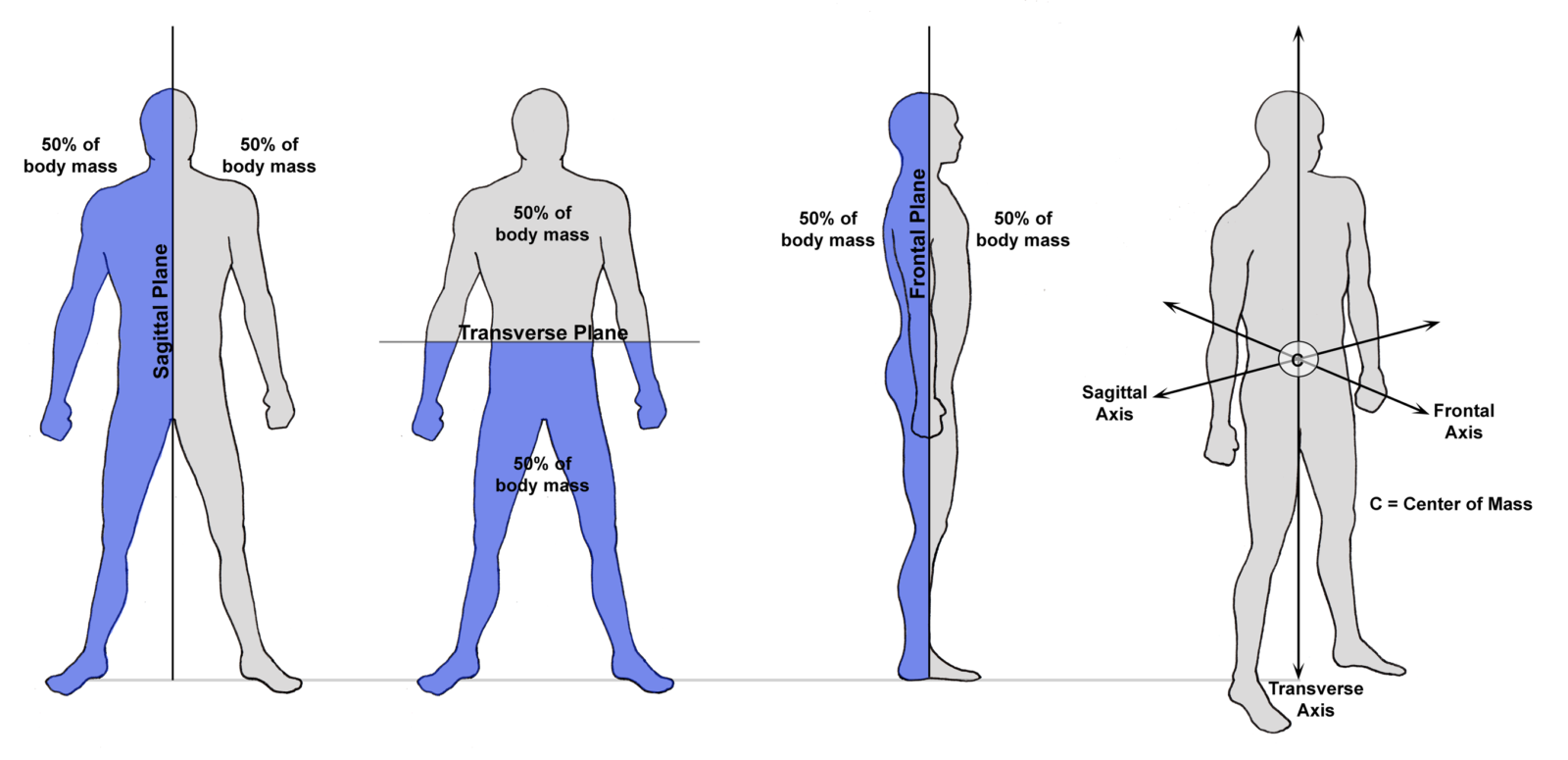
See figure 1.3 for the imaginary planes used to describe the body.

Sagittal planes are vertical planes that pass through the body from front to back. The median or midsagittal plane is the vertical plane that divides the body into right and left halves.

Horizontal (Transverse) planes are parallel to the floor. They are perpendicular to both the sagittal and frontal planes.

Frontal (Coronal) planes are vertical planes which pass through the body from side to side. They are perpendicular to the sagittal plane.

Figure 1.3 The cardinal planes of the body and the body’s centre of mass

Directions

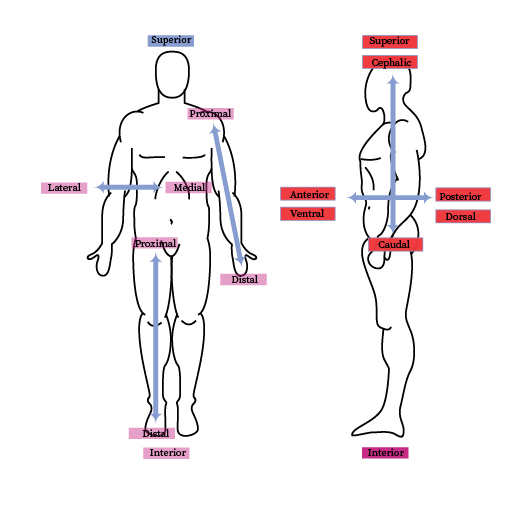
Superior means above. Inferior means below.

Anterior refers to the front of the body. A commonly-used substitute word is Ventral.

Posterior refers to the back of the body. A commonly-used substitute word is Dorsal.

Medial means toward or nearer the midline of the body.

Lateral means away from the midline or toward the side of the body.

Superficial means closer to the surface of the body.

Deep means toward the centre of the body or body part.

Proximal and distal are terms applied specifically to the limbs. Proximal means nearer to the shoulder joint or the hip joint. Distal means further away from the shoulder joint or the hip joint. Sometimes proximal and distal are used to identify the “beginning” and “end” of the GI tract-that portion closer to the stomach being Proximal while that further away being distal.

Names

Names are chosen to describe the structure or process as much as possible. An international nomenclature was adopted for anatomy in Paris in 1995. It does not use the names of people for structures. (The single exception is the Achilles tendon at the back of the foot and ankle.)

Names are chosen to identify structures properly. names identify structures according to shape, size, colour, function, and/or location. Some examples are:

TRAPEZIUS MUSCLE
TRAPEZIUS = Trapezoid shaped, like a rectangle with uneven sides.

ADDUCTOR MAGNUS MUSCLE
AD = toward
DUCT = to carry (function)
MAGNUS = very large (size)

ERYTHROCYTE
ERYTHRO = red (colour)
CYTE = cell

Cell Introduction

A cell is the microscopic unit of body organization. the “typical animal cell” is illustrated in figure 1.4. A typical animal cell includes a cell membrane, a nucleus, a nuclear membrane, cytoplasm, ribosomes, endoplasmic reticulum, mitochondria, Golgi apparatus, centrioles, and lysosomes, and I’ll talk a little about each of them.

Figure 1.4 Typical Animal Cell

Major Components of a “Typical” Animal Cell

Nucleus : The nucleus plays a central role in the cell. Information is stored in the nucleus and distributed to guide the life processes of the cell. This information is in a chemical form called nucleic acids. Two types of structures found in the nucleus are chromosomes and nucleoli. Chromosomes can be seen clearly only during cell divisions. Chromosomes are composed of both nucleic acid and protein. Chromosomes contain genes. Genes are the basic units of heredity which are passed from parents to their children. Genes guide the activities of each individual cell.

Cell Membrane : The cell membrane surrounds and separates the cell from its environment. The cell membrane allows certain materials to pass through it as they enter or leave the cell.

Cytoplasm : The semifluid found inside the cell, but outside the nucleus, is called the cytoplasm.

Mitochondria (plural) : Mitochondria are the “powerhouses” of the cell. The mitochondria provide the energy wherever it is needed for carrying on the cellular functions.

Endoplasmic Reticulum : The endoplasmic reticulum is a network of membranes, cavities, and canals. The endoplasmic reticulum helps in the transfer of materials from one part of the cell to the other.

Ribosomes : Ribosomes are “protein factories” in the cell. They are composed mainly of nucleic acids which help make proteins according to instructions provided by genes.

Centrioles : Centrioles help in the process of cell division.

Lysosomes : Lysosomes are membrane bound spheres which contain enzymes that can digest intracellular structures or bacteria.

Cell Multiplication (Mitosis)

Individual cells have fairly specific life spans. Some types of cells have longer life spans than others. During the process of growth and repair, new cells are being formed. the usual process of cell multiplication is called mitosis. There are two important factors to consider.

  • From one cell, we get two new cells.
  • The genes of the new cells are identical (for all practical purposes) to the genes of the original cell.

Hypertrophy / Hyperplasia

Hypertrophy and Hyperplasia are two ways by which the cell mass of the body increases.

With Hypertrophy, there is an increase in the size of the individual cells. No new cells are formed. An example is the enlargement of muscles due to exercise by the increased diameter of the individual striated muscle fibers.

With Hyperplasia, there is an increased in the total number of cells. An example of abnormal hyperplasia is cancer.

Atrophy is seen when there is a loss of cellular mass.